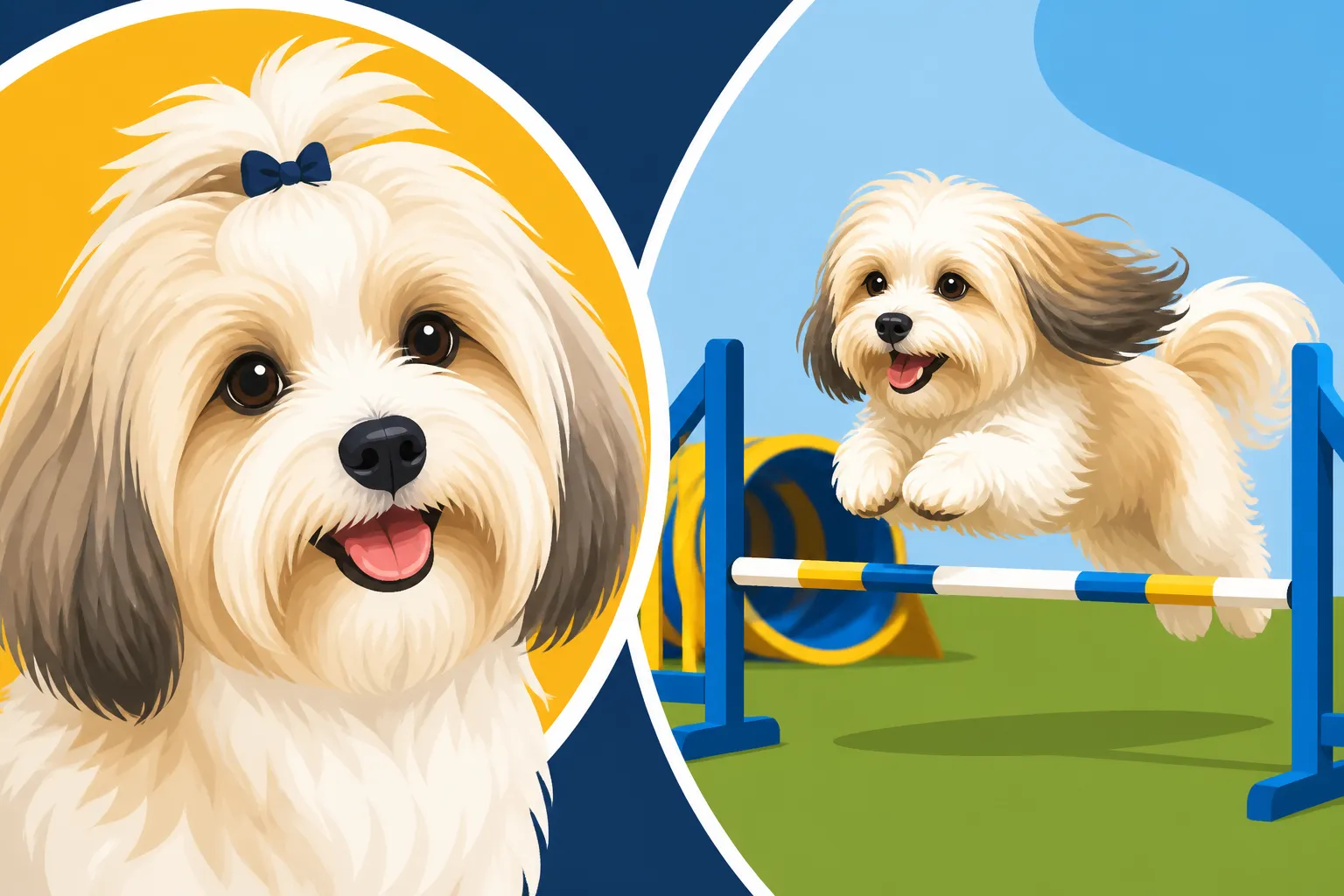
Whether a Havanese Competes in Agility
One of the most common questions I hear from Havanese owners, especially those with energetic little fluffballs, is whether their pint-sized companions can actually excel in something as dynamic as dog agility. It's a valid concern! You see those big Border Collies and German Shepherds flying over jumps and through tunnels, and it's easy to wonder if a small, long-coated Havanese has what it takes. This guide will dive deep into how a Havanese can absolutely thrive in agility, from their natural aptitudes to the best ways to get started, and even how to overcome some common hurdles, proving that these delightful dogs are far more than just lap warmers.
The Havanese Temperament and Agility Potential
It's easy to look at a Havanese and think "house dog," but these little dynamos carry a surprising amount of athleticism and a keen mind, making them wonderfully suited for dog agility. Their historical role as charming companions to Cuban aristocracy didn't involve clearing obstacles, but their intelligence and desire to be close to their people translate beautifully into a sport that requires teamwork and quick thinking.
Innate Drive and Trainability
Havanese are known for their bright, intelligent minds and a real eagerness to please their humans, which are both crucial traits for success in agility. They are often described as "Velcro dogs" because of their strong bond with their owners, and this connection forms the bedrock of an effective agility team. When your dog is constantly looking to you for direction and approval, training becomes a joyful collaboration rather than a chore.
Their intelligence means they pick up new commands and sequences remarkably quickly. You might be surprised at just How Fast a Havanese Learns a New Trick, making the progression through agility exercises feel rewarding for both of you. What they might lack in sheer speed compared to a larger breed, they often make up for in their quick comprehension and ability to navigate complex courses with precision. It's less about raw power and more about their mental agility and responsiveness. They genuinely enjoy the challenge and the focused attention they receive, transforming training into a fun game they're always eager to play.
Physical Attributes for Agility
While a Havanese might not look like your typical agility dog, their physical makeup actually offers several advantages. They are sturdy little dogs, not delicate, and their relatively short stature and compact build allow for quick turns and a low center of gravity. This means they can pivot on a dime and maintain balance, which is incredibly useful when zipping around cones or tackling a tight weave pole entry.
Their springy gait, often described as "bouncy," helps them with jumps and maintaining momentum. Don't let their long coats fool you; underneath all that fluff is a well-muscled, agile body. Of course, keeping them in good physical condition is paramount, and ensuring they are at a healthy weight will protect their joints as they bound over obstacles. Regular exercise, even beyond agility practice, is important. How Much Exercise a Havanese Needs might surprise some, but it contributes significantly to their overall fitness for sports like agility.
Getting Started with Agility Training for Your Havanese
Diving into agility doesn't mean you need an Olympic-level athlete from day one. It's a journey, and starting with a solid foundation is key, especially for a Havanese puppy. Building confidence, teaching basic manners, and introducing equipment slowly will set your dog up for success and make the experience fun for everyone.
Puppy Foundations and Socialization
The journey into agility often begins long before your Havanese ever sees an A-frame. For puppies, it’s all about positive experiences and building a strong relationship with you. Early socialization, exposing your puppy to various sights, sounds, people, and other friendly dogs, is critical. A well-socialized Havanese will be more confident and less distracted in a busy training environment. Puppy classes are fantastic for this, providing controlled interactions and teaching you how to communicate effectively with your new companion during The First Year With a Havanese Puppy.
Beyond formal classes, simply making daily life a positive learning experience is invaluable. Encouraging curiosity, rewarding brave exploration, and establishing a consistent routine all contribute to a well-adjusted dog ready to take on new challenges. Many online training platforms, like BAXTER & Bella, offer comprehensive puppy programs that can guide you through these crucial early stages from the comfort of your home, focusing on positive reinforcement techniques that truly resonate with the Havanese's eager-to-please nature.
Basic Obedience and Impulse Control
Before any fancy jumps or tunnels, your Havanese needs a rock-solid foundation in basic obedience. Commands like "sit," "stay," "come," and a reliable recall are non-negotiable. In agility, your dog will be off-leash, navigating obstacles based solely on your verbal cues and body language, so their understanding of these basics needs to be impeccable. Impulse control is equally important. Imagine your Havanese zooming towards a tunnel, but you need them to go to the weave poles instead. Can they halt, change direction, and follow your next command?
Training for impulse control can involve simple games like "leave it" with treats or toys, or practicing waiting patiently before being released to eat or play. This isn't just about obedience; it's about building focus and teaching your Havanese to pay attention to you amidst distractions. Without these fundamentals, an agility course can quickly devolve into a chaotic free-for-all. Consistency and positive reinforcement are your best tools here, making training sessions short, fun, and always ending on a high note.
Introducing Obstacles Safely
When it's time to introduce agility equipment, always prioritize safety and positive associations. For a Havanese, this means starting with low heights and small steps. Don't throw them into a full-sized tunnel or a towering A-frame right away. Begin with a very short, wide tunnel on flat ground, encouraging them through with treats and praise. Jumps should initially be set at the lowest possible height, or even just a bar on the ground for them to step over.
Weave poles can be introduced by guiding them through with an open channel, gradually narrowing the path until they understand the weaving motion. The goal is to build confidence and excitement for each obstacle. If your Havanese shows any hesitation or fear, back off and simplify the exercise. Many owners find it helpful to acquire some basic backyard agility equipment, readily available on platforms like Amazon, to practice in a low-pressure environment before joining a class. This allows you to build foundational skills and reinforce a positive attitude toward the equipment at your Havanese's own pace.
Common Challenges and How to Overcome Them
Every dog and handler team faces unique challenges in agility, and Havanese are no exception. Their charming personalities, while wonderful, can sometimes present specific quirks on the course. Recognizing these potential hurdles early on can help you prepare and develop strategies to ensure a smooth, enjoyable agility journey.
Motivation and Focus Issues
While Havanese are generally eager to please, they are also incredibly clever and can sometimes have a mind of their own if they're not fully engaged. Maintaining their motivation and focus, especially in a busy environment with other dogs and exciting smells, can be a challenge. They might decide a spectator's dropped treat is more interesting than the jump you're asking them to take, or they might get a case of the "zoomies" mid-course.
The key here is high-value rewards and making you the most exciting thing on the course. Experiment with different treats – tiny pieces of cheese, cooked chicken, or squeaky toys – to find what truly motivates your Havanese. Keep training sessions short and upbeat to prevent boredom, and incorporate lots of praise and play. If focus is an issue, practice in increasingly distracting environments, starting with your quiet backyard and slowly moving to places with more ambient noise or mild distractions. Remember, a Havanese thrives on connection, so celebrate every success, no matter how small, to keep their spirits high and their eyes on you. This is where their "circus dog brain" can be a huge asset; they love to perform for applause! The Circus Dog Brain Inside a Havanese truly wants to entertain.
Navigating Obstacles with a Small Stride
One physical characteristic that might pose a slight challenge for a Havanese is their smaller stride length compared to larger breeds. This can affect how they approach and clear obstacles, particularly spread jumps or those requiring a specific number of strides between elements. For instance, a sequence that's perfectly spaced for a Border Collie might require more steps or an awkward adjustment for a Havanese.
This isn't a barrier to success, but it does mean you, as the handler, need to be mindful and adapt your handling techniques. You might need to adjust your pace, choose slightly different lines, or use more specific verbal cues to help your Havanese maintain rhythm and clear obstacles cleanly. Agility instructors experienced with small breeds can offer invaluable advice on how to navigate these challenges. They often teach handlers to use their body language and verbal cues to "collect" or "extend" their dog's stride, allowing the Havanese to find their optimal pace and stride length for each obstacle.
The Barking and Excitement Factor
Havanese are known for being vocal, and their excitement can sometimes manifest as barking, especially when they're having a blast on the agility course. This might be a joyful "woo-hoo!" bark as they zoom through a tunnel, or a more persistent "hurry up, I'm ready for the next one!" bark while waiting for their turn. While this can be endearing, excessive barking can be distracting to other teams or even to your own Havanese if it interferes with their focus.
Addressing this involves a combination of management and training. If your Havanese barks while waiting, practice "settle" commands in a calm, quiet place, then gradually introduce distractions. During active training, you can use a "quiet" cue and reward them for moments of silence. Sometimes, a burst of energy and excitement needs an outlet; a quick game of fetch or a short run before their turn can help them burn off some of that pent-up enthusiasm. Remember that The Barking a Havanese Does at Every Sound is often a sign of their alert and communicative nature, so the goal isn't to silence them completely, but to manage it so it doesn't hinder their performance or the enjoyment of others.
The Different Levels and Types of Agility Competitions
If you and your Havanese catch the agility bug, you might eventually consider entering competitions. The world of dog agility is incredibly diverse, with various organizations offering different levels and types of classes, making it accessible and fun for dogs of all sizes and experience levels.
Novice to Advanced Classes
Agility competitions are typically structured in levels, allowing teams to progress as their skills improve. You'll usually start in Novice or Foundation classes, where the courses are simpler, the equipment is standard, and the focus is on developing confidence and accuracy. As you and your Havanese gain experience and master the basics, you'll move up to Intermediate, Open, and then eventually to Excellent or Master levels. These higher levels feature more complex course designs, faster times, and require more nuanced handling.
The beauty of this progression is that it allows your Havanese to learn and grow at their own pace. There's no pressure to be perfect from the start. Each level introduces new challenges, like harder weave pole entries, more difficult discriminations (choosing between two close obstacles), or longer sequences. Many organizations also offer different divisions based on the handler's experience or the dog's size, ensuring that a Havanese is competing against other dogs of similar height. This means they'll clear appropriate jump heights, keeping the sport safe and fair for our smaller companions. Indeed, Whether a Havanese Can Earn Trick Titles is a testament to their ability to master complex tasks, agility included.
Sanctioning Bodies and Their Rules
There are several national and local organizations that sanction agility trials, and each has its own set of rules, course designs, and titles. In North America, popular organizations include the American Kennel Club (AKC), United States Dog Agility Association (USDAA), North American Dog Agility Council (NADAC), and United Kingdom Agility International (UKI), among others. Each organization offers unique challenges and caters to slightly different styles of agility.
For example, AKC agility is often seen as a fast-paced, precise sport, while NADAC courses might emphasize more flow and distance handling. Understanding the differences between these organizations can help you choose the best fit for you and your Havanese. Some might have lower jump heights for small dogs, or different requirements for certain obstacles. If you're serious about competing, it's wise to attend a few trials as a spectator to see the different styles in action and talk to experienced handlers. This helps you understand what to expect and which competitive path might be most enjoyable for your Havanese.
| Agility Organization | Typical Course Style | Focus for Small Dogs | Entry Level |
|---|---|---|---|
| AKC (American Kennel Club) | Fast, technical, precise | Standard jump heights by size, emphasis on accuracy | Novice |
| USDAA (United States Dog Agility Association) | Challenging, often complex sequences, various games | Specific jump height divisions for small breeds | Starters |
| NADAC (North American Dog Agility Council) | Flowing courses, emphasizes distance handling and speed | Lower jump heights, focus on dog's independence | Intro |
| UKI (United Kingdom Agility International) | International-style courses, varied challenges | Specific jump heights, open to all breeds/types | Beginners |
Always check the specific organization's rules and regulations, as they can change.
Beyond Competition: Agility for Fun and Bonding
While competing can be a thrilling goal, it's essential to remember that agility, at its heart, is a fantastic way to engage your Havanese, keep them fit, and strengthen your bond. Many Havanese owners participate in agility purely for the joy it brings, without ever stepping foot into a formal competition ring.
Backyard Agility for Mental and Physical Exercise
You don't need a fancy training facility to enjoy agility with your Havanese. A simple backyard setup can provide hours of mental and physical stimulation. You can improvise obstacles using household items: a broomstick across two chairs for a jump, a hula hoop to run through, or even a child's tunnel for them to explore. As your Havanese gains confidence, you can invest in more purpose-built equipment. As mentioned, Amazon offers a wide range of affordable, portable agility kits that are perfect for home use.
Practicing in your backyard allows you to experiment with different sequences and handling techniques in a relaxed, pressure-free environment. This is particularly beneficial for a Havanese, who thrives on one-on-one attention and can sometimes be overwhelmed by busy class settings initially. It's a wonderful way to provide them with structured exercise that taps into their natural intelligence and athleticism, preventing boredom and potential behavioral issues that can arise from under-stimulation. It’s a dedicated playtime that truly engages their minds and bodies.
Strengthening Your Bond Through Play
At its core, agility is a partnership. It requires clear communication, trust, and a deep understanding between you and your Havanese. Every time your Havanese successfully navigates an obstacle based on your cue, every celebratory "good dog!" and happy wiggle reinforces that incredible connection. The shared experience of learning, problem-solving, and overcoming challenges together creates an unbreakable bond.
Think of it as a dynamic dance where you are the lead and your Havanese follows your every move, anticipating your next signal. This constant interaction, the focus required from both of you, and the sheer fun of it all deepens your relationship in ways that a simple walk around the block cannot. It builds confidence in your Havanese, knowing they can tackle anything with you by their side, and it builds your confidence as a handler. Whether you dream of ribbons and titles or simply want to have an amazing time with your furry best friend, agility offers a unique and incredibly rewarding path to a stronger, happier partnership with your Havanese. It’s proof that a Havanese still wants to play well into their senior years, and agility can keep their minds and bodies young.
Disclaimer
This article is for general informational purposes only and does not constitute professional advice. Laws, prices and regulations vary by location and change over time. Consult a qualified professional for guidance on your specific situation.