Whether a Havanese Suits a Family With Young Children
A Havanese can be a cheerful, affectionate family dog, but a small child’s enthusiasm and a small dog’s physical limits can be a tricky mix. This guide explains what living with a Havanese and young children is really like, how to keep both safe, and what to consider before bringing one home.
What makes a Havanese a possible fit for a family
Their social nature can work well with family life
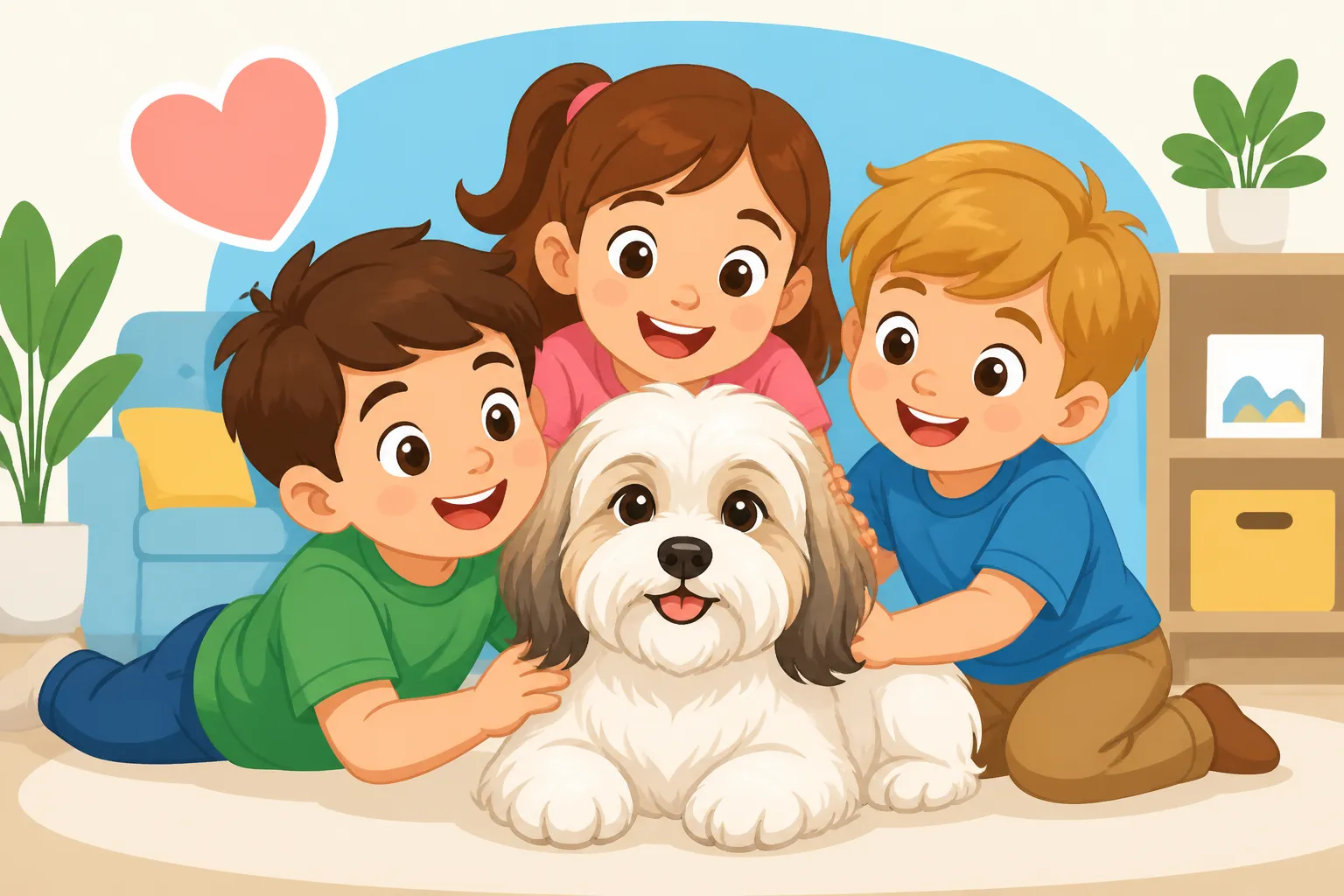
Havanese are companion dogs, and many enjoy being close to the people in their household. A well-socialized Havanese may happily follow children from room to room, join a quiet game on the floor, or settle near the family during a busy evening. Their playful, people-oriented temperament can make them engaging companions for children who are old enough to interact gently and follow simple rules.
But “family-friendly” does not mean a dog automatically enjoys every kind of child behavior. A Havanese may love a calm game of fetch and still dislike being hugged, chased, woken from a nap, or picked up without warning. Temperament varies between individual dogs, too. A puppy’s early experiences, inherited traits, health, and past handling all influence how comfortable that dog feels around children.
It helps to think of a Havanese as a companion, not a toy or a guaranteed playmate. Children can learn to invite the dog to interact and accept it when the dog walks away. For more on how a Havanese may behave around children, see A Havanese in a House With Children and Whether a Havanese Is Safe With Toddlers.
Small does not mean delicate, but it does mean vulnerable
Havanese are sturdier than their fluffy appearance might suggest, but they are still small dogs. A toddler who falls while learning to walk can land on a dog. A child who grabs a collar, hugs too tightly, or lifts a puppy awkwardly can cause pain or injury, even without meaning to. The risk is not that every Havanese is unusually fragile; it is that a size difference gives a young child less room for error.
This matters most during ordinary, hectic moments: a child rushing through a doorway, a dog sleeping beside the sofa, or a puppy being carried from room to room. Adults need to manage those situations rather than expect a young child to reliably judge the dog’s comfort or physical limits. A useful starting point is to teach children to sit on the floor when interacting with the dog and to let an adult handle lifting.
For more on the physical side of this relationship, read Whether a Havanese Is Fragile Around Children and Whether a Child Can Injure a Havanese by Dropping It. If a dog shows new sensitivity to touch, limps, or begins avoiding ordinary handling, contact a veterinarian instead of assuming it is simply being difficult.
The child’s age and behavior matter more than the breed label
A preschooler who can pause when asked and use gentle hands presents a different situation from a toddler who is still learning not to grab. Even a kind, patient dog may become uncomfortable if it is repeatedly chased or disturbed while eating. And even a child who understands the rules may forget them when excited.
Look at your actual household rather than an ideal version of it. Is an adult usually close enough to supervise? Can the dog retreat to a quiet place? Are children willing and able to follow simple rules with reminders? If your home is often crowded or noisy, can you create a reliable break for the dog? These practical details can matter more than whether the breed is generally described as affectionate.
If you are weighing up a toddler household in particular, Whether a Havanese Suits a Family With Toddlers can help you think through that decision. The central question is not whether Havanese are “good with kids” in the abstract. It is whether the adults in your home can keep interactions safe and give the dog a choice about when to join in.
How to keep children and a Havanese safe together
Supervise actively, not from across the room
Young children and dogs should not be left alone together. Active supervision means staying close enough to intervene before a child climbs on the dog, blocks its escape, or reaches into its bed. Watching from another room, listening while cooking, or assuming the dog will move away is not the same thing.
Supervision is especially important around food, toys, and rest. Give the Havanese a quiet area where children cannot follow it, and make that area a firm “leave the dog alone” space. Use a baby gate or exercise pen if verbal reminders are not enough. A crate can also provide a retreat if the dog is comfortable using it, but it should never become a place where a child reaches in to pet or play.
If you are setting up a safe zone, plan where the barrier will go before the dog arrives. Chewy may be one place families compare gates, pens, or dog beds, but choose equipment based on fit, stability, and how your child is likely to use it—not just appearance. A barrier only helps when adults consistently keep it in place.
Teach simple rules children can actually follow
Long explanations are hard for young children to remember in the moment. Short, repeated rules are more useful. For example: “Let the dog come to you,” “Pet gently on the shoulder,” and “Leave the dog alone when it is eating or resting.” An adult can model each rule and calmly interrupt when a child forgets.
Avoid encouraging children to hug, carry, chase, or pull at the dog. Many people see hugging as affectionate, but a dog may experience it as restraint. If an adult does pick up the Havanese, support its body securely and keep the child at a safe distance. When the dog is on the floor, let it approach rather than cornering it under a table or in a narrow hallway.
Children also need to learn that a dog’s signals count. Turning away, moving off, licking its lips, yawning when not tired, holding its body stiffly, or trying to hide can mean the dog needs space. Those signs do not automatically mean a bite is coming, but they are a reason for an adult to calmly separate the dog and child. Never punish a growl; it is a warning that the dog is uncomfortable, and the immediate priority is to create space.
Make grooming and handling calm, predictable experiences
A Havanese’s coat needs regular care, and a family dog may also need routine handling for brushing, bathing, nail care, and vet visits. Children can be part of gentle care when an adult supervises, but they should not be responsible for holding a squirming dog or pulling at knots. A tangled coat can be uncomfortable, and a child who tries to brush through a mat may tug the skin.
Start with brief, positive experiences: let the dog see the brush, reward calm behavior, and stop before either the dog or child becomes frustrated. A child might help place a treat on the floor while an adult brushes one easy area. The adult remains in charge of the tool and the dog’s comfort. For a fuller picture of grooming demands, see What Nobody Warns a Havanese Buyer About.
Set aside grooming supplies where children cannot use them unsupervised. If you compare brushes, combs, or dog-safe grooming products through Chewy or another retailer, check that each item suits the dog’s coat and use it according to its instructions. When a dog resists handling, do not force a long session; ask a groomer or veterinarian for guidance if the behavior is persistent or seems connected to pain.
Choosing a puppy or adult dog for a home with children
A puppy brings flexibility and a lot of supervision
A puppy can grow up with children and learn household routines from the beginning, which appeals to many families. But a puppy is not automatically easier around kids. Puppies nip, jump, chew, startle easily, and need frequent rest. A child’s fast movements and high-pitched excitement may make it harder for a puppy to settle, while a puppy’s sharp baby teeth can hurt even during play.
The early months require close adult involvement. You will need to manage naps, toileting, safe play, training, and grooming practice while also helping children respect the puppy’s limits. A puppy that is repeatedly woken or chased may become overwhelmed rather than “get used to it.” Predictable quiet time is part of raising a confident dog.
Think realistically about the household workload. If the adults are already stretched by childcare, work, or a major move, waiting may be kinder to everyone. Having children at home can offer opportunities for positive social experiences, but only when an adult has time to guide them.
An adult dog may offer a clearer picture of temperament
With an adult Havanese, you may have more information about the dog’s size, energy, comfort with handling, and previous experiences. That can be helpful in a home with young children, especially if the dog has already lived successfully with respectful kids. Still, a dog’s history does not guarantee how it will respond to your particular children, home, or routines.
Ask specific questions about the dog’s behavior around children, food, toys, grooming, and being disturbed while resting. Arrange a careful introduction in a calm setting, with adults managing distance and giving the dog a way to move away. Watch whether the dog can relax, take breaks, and re-engage voluntarily. A short, successful meeting is useful information, not proof that the adjustment period is over.
Avoid choosing a dog only because it appears quiet during one visit. Some dogs freeze or stay still when unsure, and that can be mistaken for calmness. A responsible rescue, breeder, or behavior professional should be willing to discuss both strengths and limitations. For a related perspective, see Whether a Havanese Is Safe With Toddlers.
Compare the family’s needs before deciding
The table below can help you assess the fit. It is not a pass-or-fail test; a concern may be manageable if the adults have a clear plan.
| Question | More favorable sign | Reason to pause and plan |
|---|---|---|
| Can an adult supervise interactions? | An adult can stay nearby and step in promptly | Children and dog would often be left together without close oversight |
| Does the dog have a child-free retreat? | A gated bed or quiet room is consistently protected | The dog has nowhere to rest without being approached |
| Can children follow simple rules? | They can practice gentle contact with reminders | They regularly grab, chase, or climb on pets |
| Is there time for puppy care? | Adults can handle training, toileting, rest, and grooming | The family expects children to take primary responsibility |
| Can the dog opt out? | Adults can separate everyone calmly when needed | The home layout makes it difficult for the dog to move away |
| Are expectations realistic? | The family wants a companion, not a built-in babysitter | The dog is expected to tolerate constant handling or entertain children |
Helping the relationship grow over time
Build positive interactions in short, low-pressure moments
The best early goal is peaceful coexistence, not an instant best-friend bond. Let the Havanese observe family life from a comfortable distance. When the dog chooses to approach, a child can offer a gentle stroke with an adult’s help, then pause to see whether the dog stays or moves away. Ending an interaction while it is still going well helps prevent the dog from feeling trapped.
Use simple routines. Children can help an adult place the dog’s food bowl down, toss a toy across an open area, or reward a calm sit. Avoid games that involve grabbing, tugging at the dog, or encouraging it to leap against a child. Keep play short enough that the dog does not become overexcited and the child can still follow instructions.
If the Havanese avoids a child, do not force contact or ask the child to “win it over” by crowding the dog with treats. Give the dog more room and make the environment calmer. Trust is built through repeated experiences in which the dog can approach, pause, and leave without being pursued.
Keep adult responsibility in place as the children grow
Children can take on small dog-care jobs as they mature, but an adult remains responsible for the dog’s welfare. A child may help refill a water bowl or participate in a supervised training game; an adult should still check that the dog is fed, exercised, groomed, and receiving veterinary care. This protects the dog and prevents an understandable gap between what a child promises and what they can reliably manage.
As children grow, revisit household rules rather than assuming they no longer matter. A school-age child may understand that the dog needs space but still get carried away during a birthday party or playdate. Visitors need the same guidance as family members, especially if they are unfamiliar with small dogs. A gate, leash, or separate room can be useful when the house is busy.
Consider the home’s other practical needs too. A Havanese needs exercise, companionship, and coat care, not simply a child’s attention. If children are excited to help choose treats or supplies, an adult can check ingredients and suitability before purchasing; Chewy is one retailer families may use to compare everyday dog-care items, but the dog’s needs and a veterinarian’s advice should guide the choice. For a broader overview of the breed’s household fit, see Whether a Havanese Suits a First Time Dog Owner.
Know when extra help is appropriate
If a Havanese growls, snaps, guards food, or repeatedly tries to escape from a child, separate them calmly and prevent a repeat of the situation. Do not scold the dog for warning behavior or make a child approach to “show it there is nothing to fear.” A veterinarian can check for pain or illness, and a qualified reward-based trainer or veterinary behavior professional can help identify triggers and create a safety plan.
It is also worth seeking guidance before a problem becomes severe. If the dog stiffens whenever a child reaches toward it, or the child cannot reliably respect boundaries, add physical separation while you work on the issue. For more on the specific challenges of handling, see Whether a Havanese Tolerates Rough Handling.
A Havanese may suit a family with young children when adults are prepared to supervise, teach gentle behavior, and protect the dog’s right to rest and retreat. The breed’s affectionate nature can be a lovely match for family life, but safety depends on the individual dog and the routines the adults establish—not on a breed label alone.
Disclaimer
This article is for general informational purposes only and does not constitute professional advice. Laws, prices and regulations vary by location and change over time. Consult a qualified professional for guidance on your specific situation.