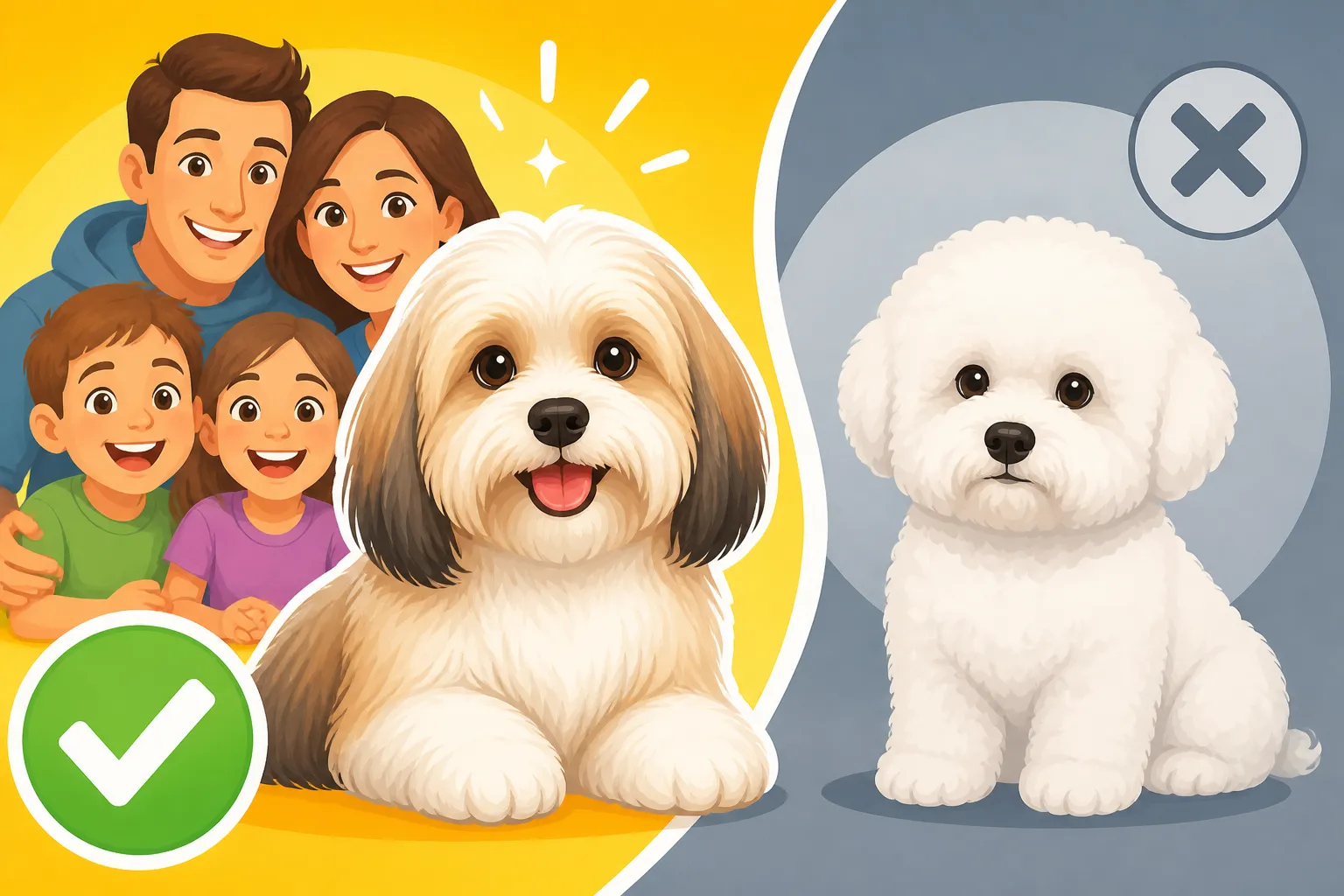
Havanese or Bichon Frise for a Family
Choosing between a Havanese and a Bichon Frise can feel like splitting hairs: both are small, affectionate companion dogs with cheerful personalities and coats that need regular care. The better family fit depends less on which breed is “nicer” and more on your children’s ages, daily schedule, tolerance for grooming, and how much time someone is home.
Havanese and Bichon Frise at a glance
Temperament and family life
Both breeds were developed as companion dogs, and both tend to enjoy being near their people. A Havanese is often described as lively, curious, and tuned in to household activity. Many enjoy learning tricks and joining in with family routines, whether that means following a parent around the kitchen or settling beside a child doing homework.
Bichon Frises are also typically cheerful and sociable. Their friendly manner can make them appealing family companions, though individual dogs vary. A Bichon may be playful and outgoing, or more reserved until it has had time to get comfortable. The same is true of Havanese. Breed tendencies are useful starting points, not guarantees about a particular puppy or adult dog.
Neither breed is a furry toy for children to carry around. Their small size makes gentle handling important, especially with toddlers who are still learning to control their movements. Families comparing the breeds may also want to read Whether a Havanese Suits a Family With Young Children and Whether a Havanese Is Fragile Around Children. The practical question is not simply whether a dog likes children; it is whether adults can supervise interactions and teach children to give the dog space.
Size, activity, and everyday adaptability
Both breeds can fit into a range of homes, including apartments, provided their daily needs are met. A yard is not a substitute for walks, play, training, and companionship, and neither breed needs a large property simply because it is a dog. Havanese often bring a springy, playful energy to the day, while Bichons also enjoy activity and games. Neither should be assumed to be a quiet lap dog all day.
A Havanese may suit a family that wants a small dog to include in everyday outings and interactive play. A Bichon may suit a family looking for a sociable companion with a similarly cheerful outlook. In either case, plan for regular walks, indoor play, and short training sessions. For a more detailed look at the Havanese’s activity needs, see How Much Exercise a Havanese Needs.
| Family consideration | Havanese | Bichon Frise |
|---|---|---|
| Typical personality | Lively, responsive, and people-focused | Cheerful, sociable, and often playful |
| Home fit | Can adapt to apartments or houses with daily activity | Can adapt to apartments or houses with daily activity |
| Grooming commitment | Regular brushing and professional coat care may be needed | Frequent coat care and professional grooming may be needed |
| With children | Can be affectionate, but needs gentle handling and supervision | Can be affectionate, but needs gentle handling and supervision |
| Alone-time planning | May struggle if left alone for long stretches | May also find long periods alone difficult |
| Best comparison question | Does the family want an interactive companion and can it manage coat care? | Does the family want a sociable companion and can it manage coat care? |
The table offers a broad comparison, not a promise about any individual dog. Age, early socialization, health, temperament, and the care a dog has received all shape how it behaves at home.
Grooming, shedding, and household routines
Coat care is a real weekly commitment
A Havanese coat is generally long and silky when kept long, while a Bichon’s coat has a different, fuller texture that is often maintained in a rounded trim. Both coats can tangle or mat if care slips, so choosing between them does not mean choosing between “easy grooming” and “hard grooming.” It means deciding which coat routine and haircut options are more manageable for your household.
For a long-coated Havanese, brushing needs to reach down to the skin rather than smoothing only the visible top layer. Areas where friction occurs—behind the ears, under the collar or harness, and in the armpits—can tangle surprisingly quickly. A Bichon’s coat also needs consistent attention, and its curly texture can hide developing tangles. A groomer can help you understand the maintenance involved before you commit to either breed. See How Often a Havanese Must Be Brushed for more on keeping that coat manageable.
If you are comparing puppies, ask the breeder or rescue what grooming the dog is already accustomed to. A puppy that has experienced calm, gentle brushing may have an easier start than one encountering a brush, bath, dryer, and grooming table all at once. It helps to make handling a brief, positive routine at home rather than waiting until tangles have become uncomfortable.
Allergies and shedding expectations
Neither breed should be treated as a guaranteed allergy-safe choice. People can react to dander, saliva, or other allergens, and responses vary from person to person. A coat that sheds less visibly does not make a dog non-allergenic. If someone in the household has allergies, spend time around adult dogs of the breed before making a decision, and discuss the situation with a health professional if reactions are significant.
Coat management also affects what you notice around the home. Loose hair may be less obvious than with some short-coated, heavy-shedding dogs, but that does not mean there is no cleanup. Brushing, bathing, drying, and keeping bedding clean remain part of ownership. Families researching the Havanese side of this issue can read Whether a Havanese Suits an Allergy Household, while remembering that an individual reaction is more informative than a breed label.
A useful test is to consider the routine on an ordinary busy week, not just on a relaxed Sunday. If the family has sports, work shifts, school events, and travel, who will brush the dog and keep grooming appointments? You can find common grooming tools and supplies through retailers such as Chewy, local pet shops, or a groomer’s recommendations. What matters is choosing tools that suit the dog’s coat and using them gently.
Children, training, and time alone
Safe, respectful interactions with children
A patient dog can still be startled or hurt by rough handling. Children should learn not to hug tightly, pull ears or hair, disturb a sleeping dog, reach into its food bowl, or chase it when it tries to move away. Adults need to supervise, especially with younger children, and provide the dog with a quiet retreat where children do not follow.
Set expectations before the dog arrives. For example, a child can help scatter a few treats during a training session or toss a toy across the floor, while an adult handles lifting, grooming, and leash management. This gives children a positive role without putting the dog in a position where it has to tolerate uncomfortable handling. A Havanese or Bichon may be affectionate, but no breed should be expected to accept every kind of touch.
Pay attention to body language. Turning away, moving behind furniture, licking the lips, yawning when not tired, or becoming unusually still can be signs that a dog needs a break. Make it easy for the dog to step away. A household that respects those signals is more likely to build a comfortable relationship than one that assumes a small family dog should always welcome attention.
Training and being left alone
Both breeds benefit from reward-based training, gentle boundaries, and early practice with household routines. Teach basics such as coming when called, settling on a mat, walking on a leash, and being comfortable with grooming. Havanese are often keen to interact and can enjoy learning small tricks, which can make training a fun family activity. Bichons can also learn through short, engaging sessions. Keep lessons upbeat and manageable, especially for young dogs.
House-training can take patience with any small dog. A consistent routine, close supervision, and prompt trips outside after waking, eating, and playing are more useful than scolding after an accident. If children are part of the routine, an adult should remain responsible for the dog’s schedule; a child may help, but should not be expected to manage toileting or training alone.
Both breeds are people-oriented enough that long, frequent stretches alone may be challenging. A dog that has not learned to settle alone gradually may bark, become restless, or chew household items when left. Before choosing either breed, think honestly about work and school schedules, midday care, and how you will build independence. A second pet is not a guaranteed fix for loneliness. For related Havanese guidance, see Whether a Havanese Tolerates Being Alone and Signs a Havanese Has Separation Anxiety.
Choosing the right breed for your family
Match the dog to your real household
The best choice is the dog whose needs fit your actual routine, not the breed that sounds best on paper. If your family enjoys interactive play, short training sessions, and including a dog in daily life, a Havanese may be a natural contender. If you are drawn to the Bichon’s cheerful, sociable character and are prepared for consistent coat care, a Bichon may be just as appealing. Neither is automatically better with children, quieter, or easier to maintain.
Think through several ordinary scenarios. Who stays home during the day? What happens when the children have after-school activities? Can someone brush the dog and arrange grooming even during a busy month? Where will the dog rest when the house is noisy? These questions often reveal a better fit than choosing based on appearance alone. Families considering the Havanese may also find Whether a Havanese Is More Work Than It Looks and Whether a Havanese Suits a First Time Owner useful.
If you are considering a puppy, ask about the parents’ temperaments, health history, early handling, and the breeder’s approach to socialization. If you are adopting an adult dog, ask what is known about its comfort with children, grooming, other pets, and time alone. A well-matched adult dog can sometimes be a clearer choice for a family because its size and personality are already more apparent.
A practical way to make the decision
Before bringing either breed home, spend time around the breed and speak with responsible breeders, rescue organizations, or experienced groomers. Notice how the dogs respond to normal household activity and how much coat care their current owners provide. A calm meeting is more informative than a quick hello in a noisy setting, though it still cannot predict every detail of living together.
Make a family care plan. Assign an adult to oversee feeding, veterinary appointments, exercise, grooming, and training. Children can help with age-appropriate tasks, but the adult remains accountable. You may also want to budget time for supplies such as a suitable brush, comb, leash, harness, food, and enrichment toys. Retailers including Chewy can be one place to compare everyday pet supplies, while a veterinarian or groomer can advise on what is appropriate for the individual dog.
Finally, be cautious about claims that one breed is completely hypoallergenic, naturally perfect with every child, or effortless to groom. Those promises obscure the real work involved. Havanese and Bichon Frises can both become loving family companions, but each needs respectful handling, regular coat care, training, exercise, and companionship. The right match is the one your family can care for consistently, including on the hectic days when the novelty has worn off.
Disclaimer
This article is for general informational purposes only and does not constitute professional advice. Laws, prices and regulations vary by location and change over time. Consult a qualified professional for guidance on your specific situation.