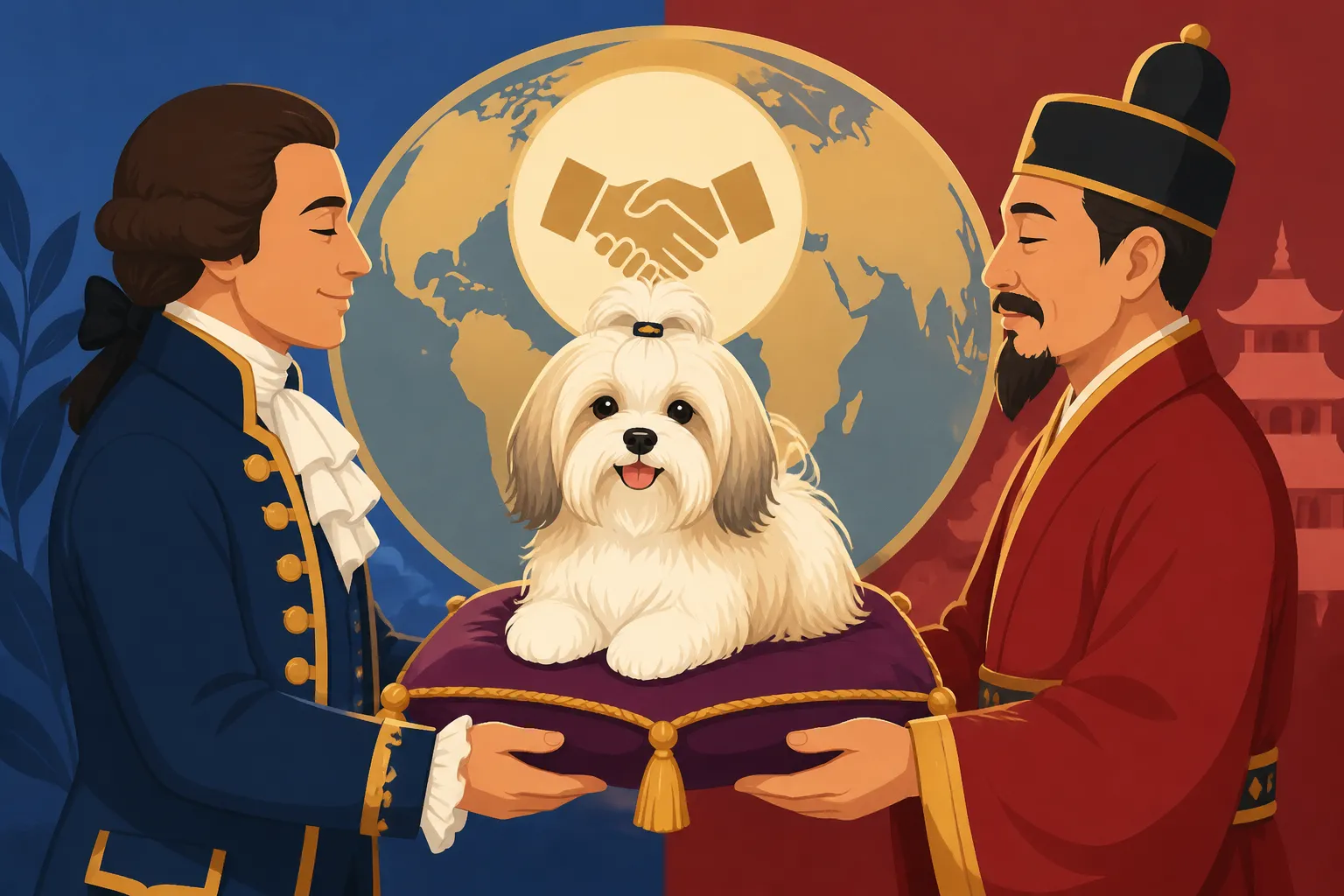
Whether Havanese Were Ever Given as Diplomatic Gifts
Stories about Havanese dogs being exchanged between diplomats can sound plausible, especially given the breed’s Cuban roots and its association with affluent households. But a plausible story is not the same as a documented tradition. This guide separates what is known about the Havanese’s history from what remains an appealing but unverified claim.
Were Havanese ever given as diplomatic gifts
There is no widely established historical record showing that Havanese dogs were routinely presented as official diplomatic gifts. Individual dogs may have been given between families or acquaintances, as dogs often are, but that is different from a documented practice involving governments, diplomatic missions, or formal exchanges between countries.
The distinction matters because online accounts can easily turn a possibility into a supposed fact. A story that a Cuban family gave a Havanese to a visiting foreign official might be true in a particular case, but without a reliable record—such as a letter, diary, newspaper account, or official document—it cannot establish that the breed had a diplomatic role.
Why the story sounds believable
Havanese dogs are closely associated with Cuba, and their history is often told alongside accounts of wealthy Cuban households and social life. Small companion dogs have also been given as personal gifts across many cultures. Put those ideas together, and it is easy to imagine a Havanese traveling from one country to another as a gesture of friendship or hospitality.
That possibility, however, should not be confused with proof. A dog carried by a traveler, given to a visitor, or exchanged between private individuals would be a personal gift—not necessarily a diplomatic one. A formal diplomatic gift is usually connected to an identifiable event or relationship between public representatives. Claims of that kind call for more than a charming breed anecdote.
The Havanese’s Cuban identity may also encourage people to assume that the breed had a special official status. It is often described as Cuba’s national dog, but cultural importance and diplomatic use are separate claims. The breed’s history and significance are worth exploring in The Havanese Is the Only Breed Cuba Ever Produced, while a related account of its social associations appears in Whether the Havanese Was a Dog of the Cuban Aristocracy.
What would count as good evidence
A convincing account would ideally identify the people involved, explain when and where the gift was made, and point to a source created close to the event. For example, a dated letter from a recipient describing the dog, a contemporary newspaper report, or an official record naming the gift would be stronger evidence than a modern retelling with no traceable source.
It is also useful to ask what the word “diplomatic” means in the story. Some accounts use it loosely to describe a dog given to a foreign visitor. Others imply that a government or official representative arranged the exchange. Those are not interchangeable. If a story does not make the distinction clear, its wording may be more dramatic than its evidence supports.
A lack of documentation does not prove that no Havanese was ever given to a diplomat. Private gifts are often poorly recorded, and many historical records have not survived. The careful conclusion is narrower: individual gifts are possible, but a recognized tradition of Havanese dogs being given as diplomatic gifts is not well established.
The Havanese’s Cuban history and its social setting
The breed’s history offers context for why gift stories have circulated, even when a formal diplomatic tradition cannot be confirmed. Havanese dogs developed in Cuba from bichon-type ancestors brought to the island from Europe. Over generations, dogs living in Cuba became associated with the island and developed into the breed now known as the Havanese.
The precise details of early breed development are not always easy to pin down. Historical accounts often rely on later descriptions, family stories, and breed histories rather than a continuous archive of records. That makes it especially important to separate broad, well-supported context from specific claims about individual dogs and events.
From bichon-type ancestors to a Cuban breed
The Havanese is part of the broader bichon family of small companion dogs. Its ancestors are generally understood to have reached Cuba from Europe, where small, long-coated companion breeds were already familiar. The dogs that developed on the island became distinct in their appearance and identity over time.
The name Blanquito de la Habana appears in accounts of the breed’s ancestry. It refers to an earlier Cuban dog associated with the development of the modern Havanese, though the precise relationship between historical types and today’s breed can be difficult to reconstruct in detail. For background on this part of the story, see The Blanquito de la Habana the Havanese Came From.
This history supports the Havanese’s connection to Cuba; it does not, on its own, establish that the breed was used as a diplomatic token. A dog can be a recognizable cultural symbol without being formally exchanged by governments. That distinction helps keep the breed’s genuine historical importance from being overstated.
Companion dogs in affluent households
Havanese dogs are often associated with prosperous Cuban families and the social world of Havana. As companion animals, small dogs could live closely alongside people in homes and social settings. Such a role makes it entirely plausible that a dog might be given as a personal gift or carried by a family traveling abroad.
Still, plausibility is not documentation. A breed’s presence in wealthy households does not establish that it was routinely offered to foreign visitors or political figures. Even if a particular Havanese was gifted to someone from another country, the event would need its own evidence before it could be described as a diplomatic exchange.
The historical picture is also broader than a single social class. Breed histories can emphasize prominent owners because their names and stories are more likely to appear in surviving accounts. That does not mean every Havanese lived in an elite household, or that the breed’s entire history can be reduced to aristocratic ownership.
| Historical question | What can be said carefully | What the claim does not prove |
|---|---|---|
| Did the Havanese develop in Cuba? | The breed is closely tied to Cuba and descended from bichon-type ancestors brought to the island. | That Cuban officials used the breed in formal diplomacy. |
| Were Havanese kept as companion dogs? | They were valued as small companion animals, including in affluent households. | That every dog belonged to an elite family or was a political gift. |
| Could an individual Havanese have been gifted to a foreign visitor? | It is plausible, as private gifts of dogs are common across cultures. | That there was a documented, recurring diplomatic tradition. |
| Does the breed’s Cuban identity make the story possible? | It explains why the idea feels culturally plausible. | That a particular gift occurred without a traceable account. |
Why the breed’s survival story is sometimes confused with gift stories
The Havanese’s twentieth-century history includes a major disruption: the Cuban Revolution and the migration of families from the island. Some families leaving Cuba brought dogs with them, and Havanese survival outside Cuba became a significant part of the breed’s modern history. This movement across borders can sometimes blur into stories about gifted dogs, even though migration and diplomacy are different events.
When people hear that dogs traveled from Cuba to the United States or elsewhere, it is natural to ask whether they were gifts. In some individual cases, a dog could have been given to another person. But the better-known account of the breed’s recovery centers on families and breeders preserving dogs—not on an official gift program.
Migration is not the same as a diplomatic exchange
Families who left Cuba faced difficult decisions about what they could take with them. A companion dog traveling with a family is part of a migration story. A dog left with relatives, passed to a friend, or given to a new owner is a personal arrangement. None of those situations automatically makes the dog a diplomatic gift.
The Havanese population outside Cuba was shaped by dogs carried by people who resettled elsewhere. Accounts of this period are covered in How the Havanese Nearly Died Out After 1959 and The Refugee Dogs Every American Havanese Descends From. These histories help explain how the breed was preserved and rebuilt without relying on an unsubstantiated diplomatic narrative.
The distinction is more than a technicality. Calling migration a diplomatic exchange can erase the role of ordinary families and breeders who cared for the dogs and maintained the breed. It can also make a complex period sound like a tidy, official transfer when the historical story involved upheaval and personal choices.
The rebuilding of the breed in the United States
The modern Havanese population in the United States was rebuilt through the efforts of people who sought out surviving dogs and developed breeding programs. Dorothy and Burt Goodale are central figures in many accounts of that work. Their role is described in Dorothy Goodale and the Rebuilding of the Havanese and How the Goodales Found Havanese in America.
This rebuilding story is sometimes retold in simplified form: a small number of dogs arrived, and the breed was restored. The fuller picture involves the people who located dogs, maintained records, and made careful breeding decisions over time. It is a story of preservation and organization, not evidence that the dogs were supplied through diplomatic channels.
That does not rule out a private gift somewhere in the breed’s history. It simply means the documented rebuilding narrative should be kept separate from a claim about official gifts. If a specific account says that a Havanese was presented to a diplomat, look for the name of the recipient, the date, and a source that can be checked independently.
How to assess a Havanese diplomatic-gift story
A responsible answer to the question is not an absolute “never.” Historical records are incomplete, and private exchanges are often hard to trace. The most accurate answer is that Havanese dogs may have been given as personal gifts, but a formal or recurring tradition of presenting them as diplomatic gifts is not well documented.
That wording leaves room for an individual event while avoiding a broad claim that the evidence cannot support. It also gives readers a practical way to evaluate new versions of the story they may encounter in breed articles, social media posts, or family histories.
Check the source, not just the wording
Start by looking for the original source behind the claim. Does the account provide a letter, newspaper story, photograph with a reliable caption, memoir, or official record? Or does it repeat the same sentence found elsewhere without naming where the information came from?
Next, check whether the source supports the exact claim being made. A photograph of a Havanese beside a visitor might show that the dog and visitor were together. It would not, by itself, prove that the dog was given as a gift, that the recipient was a diplomat, or that the exchange was official. Each step in the story needs evidence of its own.
Finally, pay attention to whether the account describes one event or a tradition. One well-supported gift would establish that an individual Havanese was given to a particular person. It would not automatically show that the breed was regularly used in diplomatic exchanges. For broader context on Cuban families and the breed, Whether Havanese Were Kept by Cuban Sugar Families can help frame the social history without treating it as proof of a specific gift.
A careful way to describe the claim
If you are discussing the breed with a child, writing a family history, or sharing a Havanese story online, you can preserve the interesting possibility without presenting it as settled fact. For example: “Havanese dogs were closely associated with Cuba, and individual dogs may have been given to visitors, but there is no well-established record of a formal diplomatic-gift tradition.”
That kind of phrasing is not dismissive. It respects the breed’s cultural history while keeping the evidence in view. It also invites better research: perhaps someone will find a contemporary letter or a documented account of a particular dog, which could support a more specific claim.
The Havanese is already an interesting part of Cuban and canine history without needing an embellished diplomatic role. Its development in Cuba, its place as a companion dog, and the efforts to preserve it through migration and breeding offer a rich story on their own. Until a specific gift can be tied to reliable evidence, it is best to treat the diplomatic-gift idea as possible for individual cases but unconfirmed as a broader historical tradition.
Disclaimer
This article is for general informational purposes only and does not constitute professional advice. Laws, prices and regulations vary by location and change over time. Consult a qualified professional for guidance on your specific situation.